
Planting
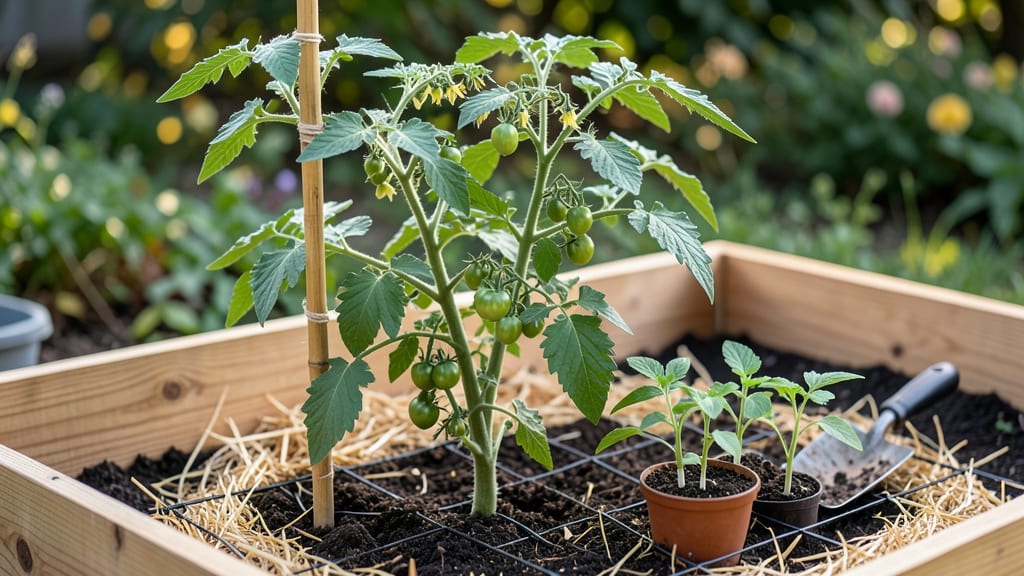
Tomato spacing in square foot gardens requires precise placement: 1 plant per square foot for small varieties, 2 plants per square foot for medium types, and 4 plants per square foot for dwarf or bush varieties. Larger indeterminate tomatoes need 1 plant per 2 square feet to ensure proper airflow and support.
Getting this spacing right isn't just about fitting more plants—it's about giving each tomato the breathing room it needs to thrive. 🌱 Determinate varieties, which grow to a fixed height, can handle closer spacing because they stop growing once they produce fruit, while indeterminate types keep growing until frost, so they need extra space to sprawl.
I've found that even with tight spacing, proper trellising can help maximize vertical growth and prevent disease by improving airflow around the foliage.
For square foot gardens, this means planning your layout carefully. A 1x1 foot grid works well for cherry tomatoes or small bush varieties, while a 1x2 foot grid gives medium-sized plants like Roma or Early Girl the room they need to develop strong stems.
Larger indeterminate varieties, like Brandywine or Sungold, absolutely need their own 2x2 foot squares—any less, and you'll risk crowded plants that struggle with pests and poor fruit production.
💡 In This Article
- Optimal Tomato Spacing by Variety Type in Square Foot Gardening
- Square Foot Tomato Planting Layouts for Maximum Yield
Optimal tomato spacing by variety type in square foot gardening
Tomato spacing in square foot gardens hinges on three key factors: growth habit, mature size, and sunlight requirements. Determinate varieties—like 'Roma' or 'Celebrity'—grow to a fixed height (typically 3-4 feet) and produce fruit all at once.
Their compact nature allows for 2 plants per square foot, since they don't need room to sprawl. Indeterminate types, such as 'Sungold' or 'Brandywine', keep growing until frost and can reach 6-8 feet tall, requiring 1 plant per 2 square feet to prevent overcrowding and disease.
The science behind this spacing comes down to airflow and sunlight exposure. Crowded plants create humid microclimates that trap moisture, promoting fungal diseases like early blight. 🌿 Proper spacing ensures each plant gets 6-8 hours of direct sunlight daily, which is critical for photosynthesis and fruit development.
For example, a 1x1 foot grid for cherry tomatoes (like 'Sweet 100') gives each plant enough room to develop strong stems and support its own weight, while also allowing easy access for pruning and harvesting.
Dwarf or bush varieties, such as 'Tiny Tim' or 'Patio Princess', are exceptions—they can handle 4 plants per square foot because their mature height is only 12-18 inches. However, even these compact plants need adequate airflow to prevent mildew.
The key is balancing density with airflow: think of it like a forest canopy. Too close, and the lower leaves suffocate; too far, and you waste garden space.
For instance, in a 4x4 foot square foot garden, you could fit 16 dwarf tomato plants, but they'd need vertical support (like stakes or cages) to keep foliage off the ground.
Another critical factor is root competition. Tomatoes have extensive root systems that spread 18-24 inches wide for indeterminate types and 12-18 inches wide for determinate ones. When roots overlap, plants compete for nutrients and water, leading to stunted growth.
This is why indeterminate varieties need more space—their roots grow deeper and wider to support their vertical growth. For example, a Brandywine tomato planted in a 1x1 foot grid will struggle, but in a 2x2 foot grid, it thrives with room to develop a robust root system.
Varietal differences also affect spacing needs. Heirloom tomatoes, like 'Cherokee Purple', often have larger leaves and fruit, requiring more space than hybrid varieties like 'Better Boy'. The leaf size alone can dictate spacing: larger leaves cast more shade, reducing airflow and increasing disease risk.
For instance, a Sungold tomato (indeterminate) with broad leaves needs 18-24 inches between plants, while a Roma tomato (determinate) with smaller leaves can tolerate 12-18 inches.
Finally, consider the garden's layout. In a 4x4 foot square foot garden, you might arrange determinate tomatoes in a 2x2 grid (4 plants) and indeterminate types in a 1x2 grid (2 plants). This maximizes yield while ensuring each plant has the space it needs to thrive.
The goal is to mimic nature: plants in the wild don't grow in crowded clusters; they spread out to access sunlight and nutrients. 🌱