
How To
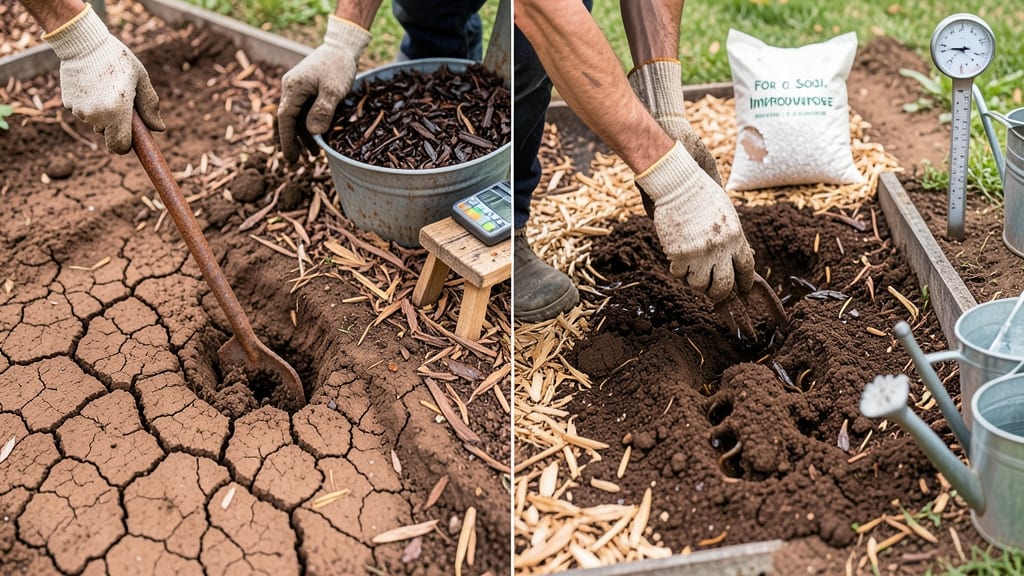
To fix clay soil for gardening, you'll need to incorporate organic matter like compost or aged manure, till in coarse sand or perlite, and avoid walking on the soil to prevent further compaction. Apply these amendments once a year for lasting improvements.
Clay soil's heavy, sticky nature makes it difficult for roots to spread and water to drain properly. 🌱 The dense particles pack tightly, creating air pockets that suffocate plant roots and trap excess moisture—leading to waterlogged conditions that invite fungal diseases.
I’ve found that breaking up this compacted structure with organic amendments not only improves drainage but also encourages beneficial microbial activity that helps plants absorb nutrients more efficiently.
For best results, focus on a mix of organic and inorganic materials. Compost adds vital nutrients while breaking up clay's dense structure, while perlite or coarse sand improves drainage without altering the soil's fertility.
The key is patience—don't expect overnight transformations, but with consistent annual amendments, your soil will gradually become looser, more workable, and far more hospitable to plant roots.
💡 In This Article
- Why Clay Soil Struggles with Plant Growth
- Top Organic Amendments for Breaking Up Clay Soil
Why clay soil struggles with plant growth
Clay soil's microscopic particles—each smaller than 0.002 millimeters—pack together like tightly stacked coins, creating a dense matrix that blocks both water drainage and air circulation. When rain falls, the water can't seep through quickly, leading to waterlogged conditions that suffocate plant roots by cutting off oxygen.
Studies show clay soils can hold 40-60% water by volume compared to sandy soils' 5-10%, making them prone to root rot and nutrient leaching during heavy rains. 🌧️
The problem worsens when clay soil dries out because those same tiny particles shrink and pull apart, creating cracks that can be 1/4-inch wide or more. While this might seem helpful for drainage, it also creates unstable growing conditions where roots struggle to establish themselves.
The dense structure also limits root expansion—roots in clay soil often grow only 1-2 inches deep compared to 6-12 inches in loamy soil, restricting a plant's ability to access water and nutrients.
Compaction makes everything worse. Heavy foot traffic, machinery, or even livestock compress the soil further, reducing pore space by up to 50%. This forces water to pool at the surface while pushing air out of the soil profile.
Without oxygen, beneficial microbes that break down organic matter and release nutrients can't thrive, creating a vicious cycle of poor plant health. The result? Stunted growth, yellowing leaves, and plants that look thirsty even when the soil is saturated. 🍃
What most gardeners don't realize is that clay soil's high nutrient content—it can hold 3-6 times more nutrients than sandy soil—isn't accessible to plants when the soil is compacted. The nutrients bind tightly to the clay particles, making them unavailable until the soil structure is improved.
This is why simply adding fertilizer won't solve the problem—you need to physically break up that dense matrix to unlock the soil's potential.
Think of clay soil like a sponge that's been squeezed dry: it holds onto water and nutrients, but they're trapped in a way that plants can't easily access. The solution lies in adding materials that create air pockets and improve drainage while maintaining the soil's natural fertility.
This is where organic amendments come into play, acting like a gentle pry bar to separate those tightly packed particles and restore balance to the soil ecosystem. 🌱