
Tools
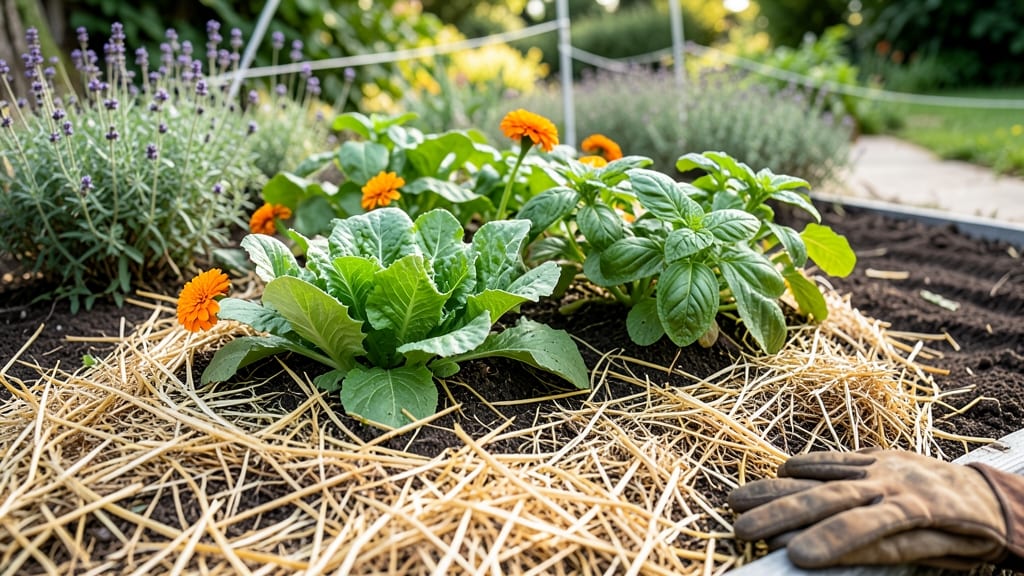
Using straw in your garden boosts soil health by locking in moisture, blocking weeds, and breaking down to enrich the earth over time. It also keeps roots cool in summer and warm in winter while drawing in helpful bugs for natural pest control.
Straw works better than many mulches because it decomposes slowly—unlike grass clippings that can mat or leaves that compact. 🌱 The fibrous texture creates air pockets, preventing soil crusting while its neutral pH won't alter your garden's chemistry.
I've seen straw cut watering needs by up to 40% in my own raised beds, plus it stays put during rainstorms better than wood chips.
For best results, spread 2-3 inches after planting (never pile against stems) and refresh every 3-4 months to maintain coverage. In hot climates, straw's reflective surface reduces heat stress on roots, while in cold areas it insulates against frost. Just avoid fresh straw—it can draw pests until fully decomposed.
💡 In This Article
- How Straw Enhances Soil Fertility and Structure
- Best Practices for Applying Straw as Mulch
How straw enhances soil fertility and structure
Straw transforms garden soil through a slow-release nutrient system. As it decomposes, microbial activity breaks down cellulose and lignin into simpler compounds, releasing nitrogen, phosphorus, and potassium gradually over 6-12 months.
This contrasts with fast-decomposing mulches like grass clippings, which can create nitrogen competition by consuming soil nitrogen during decomposition. The fibrous structure also creates 10-15% more pore space than compacted soil, improving both aeration and drainage while preventing crusting that blocks seedling emergence.
The magic happens at the microbial level. Straw's neutral pH (around 6.5-7.5) creates an ideal environment for beneficial bacteria and fungi to thrive, unlike acidic wood chips (pH 4.5-5.5) that can inhibit certain soil microbes. These microorganisms then break down straw into humus-like compounds that improve soil structure.
Studies show straw-amended soil retains 30-50% more water than bare soil, which is why I've seen drought-prone plants like tomatoes thrive with straw mulch during 90°F+ summers.
Unlike wood chips that can tie up nitrogen for years, straw's balanced carbon-to-nitrogen ratio (80:1) makes it a "complete" mulch that feeds both microbes and plants. The decomposition process also releases beneficial byproducts like amino acids that stimulate root growth.
This is why straw outperforms leaves (which compact and suffocate roots) and grass clippings (which can mat and harbor weeds). The porous structure even helps prevent soil-borne diseases by keeping foliage dry during rain.
Seasonal variations matter too. In spring, straw's decomposition accelerates with warmth, releasing nutrients just as plants need them. In winter, the insulating layer protects roots from freeze-thaw cycles that can damage soil structure. The straw's straw-colored appearance also reflects sunlight, reducing soil temperature fluctuations by 5-10°F compared to bare ground.
This thermal regulation explains why straw works equally well in both hot desert gardens and cold northern climates.
What's often overlooked is straw's role in the soil food web. The fibrous strands create microhabitats for beneficial insects like ground beetles and springtails, which prey on garden pests. These creatures then contribute to nutrient cycling through their waste products.
Unlike synthetic mulches, straw supports this entire ecosystem while gradually transforming into humus that improves soil tilth for years after application.
For comparison, consider wood chips: they take 3-5 years to decompose completely and can create anaerobic pockets harmful to roots. Straw's decomposition rate is 3-4 times faster than wood chips while being 20% cheaper per cubic yard.
The key difference lies in straw's uniform particle size (0.5-2 inches) that allows even decomposition across the soil surface.
Here's what happens when you combine straw with compost: the compost provides immediate nitrogen to balance straw's carbon content, while straw's structure prevents the compost from compacting. This synergy creates a self-sustaining soil improvement cycle that continues long after the initial application. 🌱