
Tools
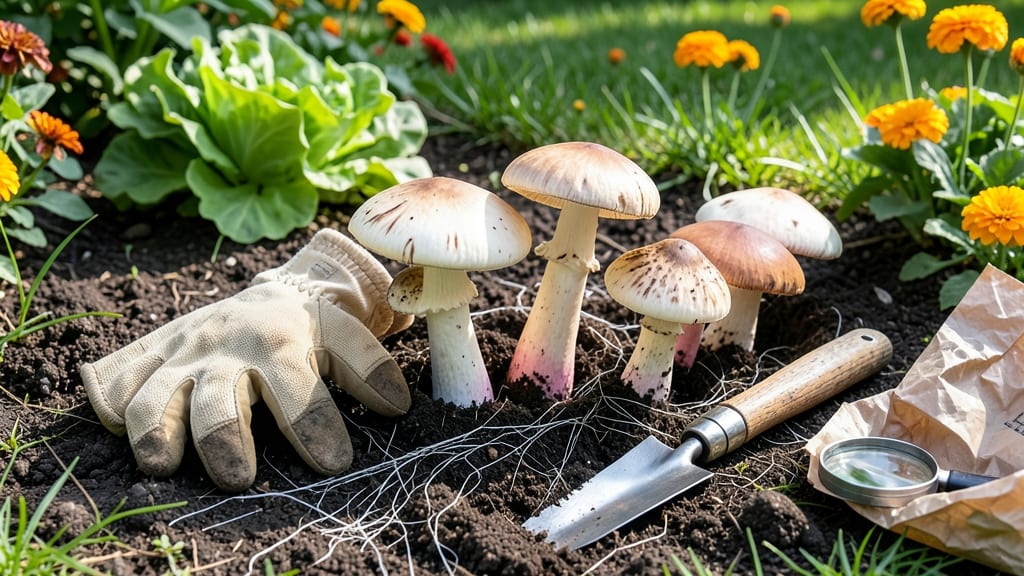
Deciding whether to remove mushrooms from your garden depends on their type: toxic varieties like death cap must be removed immediately, while beneficial fungi like chanterelles or morels can be left or sustainably harvested. Most common garden mushrooms indicate healthy soil and should remain unless they threaten plants or pets.
Whether you should remove mushrooms from your garden comes down to their impact on your ecosystem. 🌱 Toxic varieties like the death cap can be deadly if ingested by pets or children, so these must be carefully collected and disposed of properly.
On the other hand, many mushrooms—such as oyster or shiitake—act as natural soil aerators and decomposers, contributing to a thriving garden. I always recommend testing soil health first: if your garden is already rich in organic matter, mushrooms are likely doing more good than harm.
For safe removal, focus on timing and method. Early morning is ideal when mushrooms are fully hydrated and easier to extract. Use a trowel to lift them gently from the roots to avoid damaging nearby plants.
If you're unsure about a mushroom's safety, avoid touching it—some species can cause skin irritation. For toxic varieties, double-bag them in sealed plastic and dispose of them in household trash, never in compost.
💡 In This Article
- Identifying Toxic vs Beneficial Garden Mushrooms
- Safe Mushroom Removal Techniques for Garden Health
Identifying toxic vs beneficial garden mushrooms
Visual cues are your first line of defense when identifying garden mushrooms.
Toxic varieties like the death cap (Amanita phalloides) often feature a white gills and stem, a bulbous base, and a skirt-like ring that remains attached when the cap is removed. 🍄 These mushrooms typically grow in clusters near trees, especially oak or poplar.
In contrast, beneficial species like oyster mushrooms have fan-shaped caps, grow in overlapping tiers on wood or mulch, and display soft, velvety textures with no bulbous base.
Spore prints offer another critical clue. Place the mushroom cap gill-side down on white paper and cover it with a bowl overnight. Toxic mushrooms like Amanita often produce white spores, while beneficial varieties such as chanterelles leave rust-colored prints.
Regional field guides are essential—what's safe in the Pacific Northwest (like morels) may differ from Midwestern varieties. Always cross-reference with local mycological resources or apps like iNaturalist, where experts can verify identifications.
Never rely on smell or taste alone for identification—many toxic mushrooms lack a strong odor, and some edible ones can be bitter.
The death cap, for instance, has a mild, almost pleasant aroma, while the deadly destroying angel (Amanita bisporigera) emits no distinctive scent. 🚨 Misidentification can be fatal: the death cap contains amatoxins that attack the liver and kidneys, with symptoms appearing 6-24 hours after ingestion and often proving fatal even with treatment.
Consider the mushroom's growth conditions. Beneficial fungi like shiitake thrive on hardwood logs or straw, while toxic species often emerge from soil enriched with decaying plant matter. If mushrooms appear after heavy rain or in compacted soil, they're likely decomposers breaking down organic material—a good sign for your garden.
However, if they sprout in neat circles (fairy rings) under lawns, they may indicate nitrogen depletion or thatch buildup, warranting removal.
For gardeners in urban areas, watch for mushrooms growing from mulch or wood chips—these are often beneficial species like wine caps (Stropharia rugosoannulata) that help decompose yard waste. 🌱 The key is observing their behavior: do they spread rapidly and smother plants (potential threat), or do they appear in isolated patches without harming vegetation?
When in doubt, photograph the mushroom from multiple angles and consult a mycologist before taking action.
Remember that some mushrooms are only toxic when raw—cooking can neutralize certain toxins. However, this risk isn't worth taking with wild varieties.
Always err on the side of caution: if you can't positively identify a mushroom as edible through multiple verified sources, assume it's toxic and remove it immediately using proper disposal methods.