
Tools
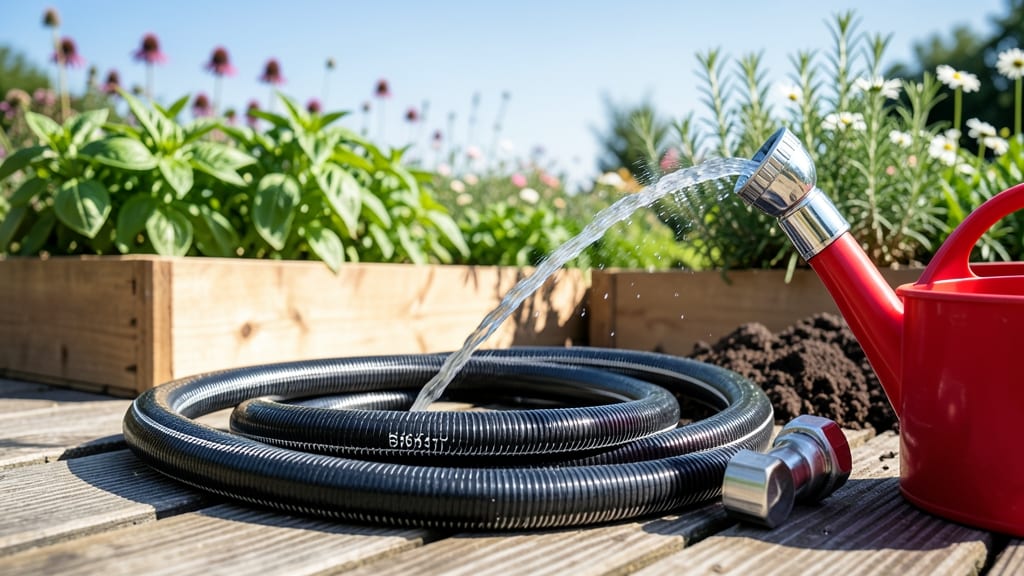
The inside diameter of a garden hose directly controls how much water flows through it and how strong that flow is: a 5/8-inch hose gives steady pressure for everyday gardening, while 3/4-inch or 1-inch hoses push more water for tasks like large irrigation systems or pressure washing. Thicker hoses also maintain pressure better over longer distances.
The inside diameter of your garden hose isn't just about how thick it feels—it's the real deal when it comes to performance. 🔥 A 3/8-inch hose might work for a small potted plant, but try using it to fill a kiddie pool and you'll wish you'd gone bigger.
The physics here are simple: wider hoses let water move faster with less resistance, so you get stronger streams and less pressure drop over 50 feet of hose.
I always recommend measuring your garden layout first—if you're dealing with long runs or multiple sprinkler heads, a 1-inch hose could save you from struggling with weak flow at the end.
What's fascinating is how this affects your watering efficiency. A 5/8-inch hose might deliver 15-20 gallons per minute (GPM) at 40 PSI, while a 1-inch hose can push 30-40 GPM at the same pressure.
That extra flow means faster watering and less time spent dragging the hose around. For pressure washers, you're looking at 1-inch minimum—anything smaller risks clogging or overheating the machine.
💡 In This Article
- How Garden Hose Diameter Impacts Water Pressure and Flow
- Choosing the Right Hose Size for Your Gardening Needs
How garden hose diameter impacts water pressure and flow
The physics behind hose diameter comes down to two key principles: the Bernoulli effect and friction loss. When water moves through a hose, it experiences resistance against the inner walls.
A narrower hose like 3/8-inch creates more friction, slowing water speed and reducing pressure—think of it like squeezing a ketchup bottle. The 5/8-inch standard offers a sweet spot: enough capacity for most tasks while keeping costs reasonable.
But here's the kicker: for every 100 feet of hose, a 3/8-inch hose loses 10-15 PSI just from friction, while a 1-inch hose loses only 3-5 PSI over the same distance. 🔥
Let's talk numbers. Water flow follows the Hazen-Williams equation, which shows how diameter affects gallons per minute (GPM). A 5/8-inch hose typically delivers 15-20 GPM at 40 PSI, while a 1-inch hose can push 30-40 GPM at the same pressure.
The math gets interesting with long runs: if you're watering a 100-foot garden bed, that 5/8-inch hose might only deliver 10 GPM at the end due to pressure drop, while a 1-inch hose maintains 25 GPM. That's the difference between a 10-minute watering session and a 30-second one.
What most people don't realize is how water velocity changes with diameter. The 1-inch hose moves water at 10-12 feet per second, while a 3/8-inch hose struggles at 3-5 feet per second. This velocity difference explains why larger hoses feel "stronger"—they're actually pushing water faster through the system.
For irrigation systems, this means more even coverage and less wasted water from uneven distribution. The 1-inch hose becomes particularly valuable when connecting multiple sprinkler heads, as it maintains consistent pressure across all zones.
Here's a practical example: imagine running a pressure washer with a 3/8-inch hose. At 50 PSI at the spigot, you might only get 30 PSI at the nozzle after 50 feet of hose. That's a 40% pressure loss—enough to make your cleaning task frustratingly weak.
Upgrade to a 1-inch hose, and you'll maintain 45 PSI at the end, giving you that satisfying 4,000 PSI blast when you need it. The same principle applies to filling pools or watering large lawns—bigger diameter means less energy wasted fighting friction.
For DIY calculations, use this simple rule: diameter squared roughly equals flow capacity. A 5/8-inch hose (0.625" diameter) has about 0.39 square inches of cross-section, while a 1-inch hose has 0.785 square inches—nearly double the capacity.
That's why professional irrigation systems almost always use 1-inch or larger hoses for main lines, even if they branch into smaller 5/8-inch laterals. The initial investment in a thicker hose pays off in efficiency and performance over time.
One final consideration: hose material matters too. Reinforced rubber or polyurethane hoses maintain their diameter better under pressure than cheaper vinyl hoses, which can swell or kink. This consistency means more predictable flow rates.
For maximum performance, look for hoses with braided polyester reinforcement—they resist kinking and maintain their shape, which directly impacts how well they handle water flow over time. ✨