
Tools
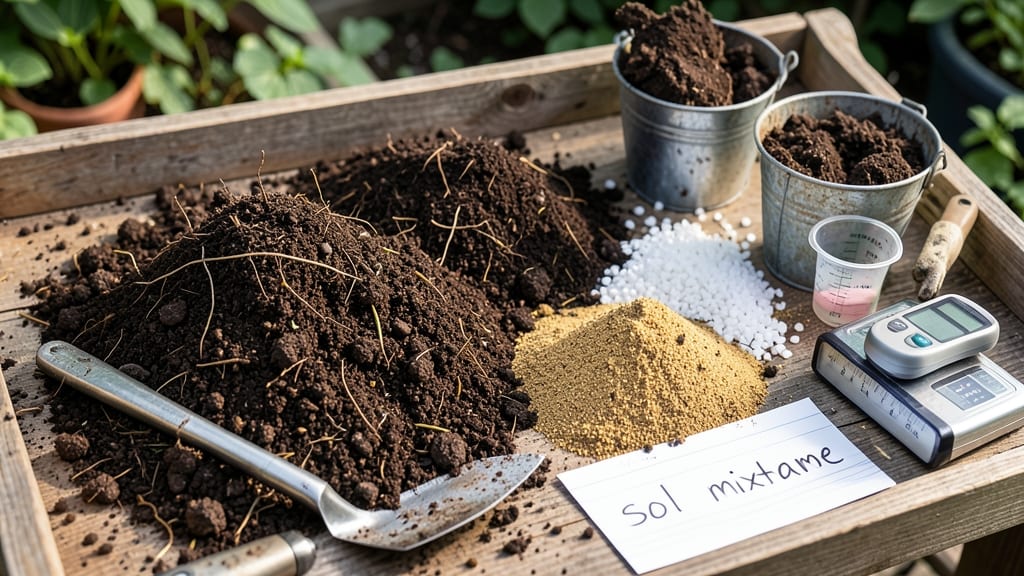
A soil mixture for vegetable gardens should combine equal parts topsoil, compost, and coarse sand or perlite for drainage, with optional amendments like aged manure or worm castings for nutrient balance. Aim for a loamy texture—60% topsoil, 30% organic matter, and 10% sand—adjusted based on clay or sandy native soil conditions.
Creating the perfect vegetable garden soil mix starts with understanding how each component works together.
The 60-30-10 ratio isn't arbitrary—topsoil provides structure, compost feeds microbes, and sand prevents compaction. 🌱 For example, leafy greens like spinach thrive in slightly richer mixes, while root vegetables need looser blends to prevent gnarled growth.
I always test my soil's drainage by filling a jar with equal parts soil and water, then shaking it vigorously—if the layers separate poorly, I know I need more sand or perlite.
Don't overlook regional adjustments either. In heavy clay soils, adding 20% perlite can transform your garden's productivity overnight, while sandy soils benefit from extra compost to retain moisture.
For tomatoes, I bump the compost ratio to 40%—they're heavy feeders that reward you with bigger yields when the soil stays consistently fertile.
💡 In This Article
- Loam Soil Composition: The Science Behind Ideal Vegetable Growth
- Customizing Your Vegetable Garden Soil Mix by Plant Type
Loam soil composition: the science behind ideal vegetable growth
Loam's legendary success as a vegetable growing medium comes from its perfect balance of 40% sand, 40% silt, and 20% clay by volume. This ratio creates microscopic air pockets that let roots breathe while holding enough moisture for consistent growth.
The sand particles (0.05-2mm) act like tiny drainage channels, while the clay (less than 0.002mm) binds nutrients and water through electrostatic charges. This structure gives loam a crumbly texture that crumbles easily between your fingers when moist—a telltale sign of optimal aeration.
The magic happens at the molecular level where organic matter (like compost) interacts with these minerals. Organic material increases the soil's cation exchange capacity (CEC)—its ability to hold and release nutrients when plants need them.
A healthy loam can hold 10-20 meq/100g of exchangeable cations (like calcium, magnesium, and potassium), compared to just 3-5 meq/100g in sandy soils.
This nutrient reservoir explains why tomatoes grown in loam produce fruit with 25% more lycopene than those in pure sand, as the plants have constant access to minerals.
Texture matters differently for different vegetables. Leafy greens like kale prefer finer textures with more silt (50% silt, 30% sand, 20% clay) because their shallow roots benefit from moisture retention. Root vegetables like carrots need the opposite—50% sand creates loose soil that prevents forking.
The ideal loam's porosity also supports beneficial microbes: a single gram contains 100 million bacteria and 10,000 fungal filaments, breaking down organic matter into plant-accessible nutrients at rates 10x faster than in pure mineral soils.
What most gardeners overlook is how temperature affects loam's performance. The ideal range is 50-75°F—below 50°F, microbial activity slows dramatically, while above 80°F, beneficial fungi like mycorrhizae struggle. This is why spring planting often yields better than summer planting in many climates.
The loam's moisture-holding capacity also creates a thermal buffer: it stays cooler in summer and warmer in winter than sandy soils, protecting delicate root systems.
For practical testing, try the ribbon test: roll a moist handful of soil between your fingers. A 2-inch ribbon that breaks easily indicates ideal loam. If it crumbles immediately, add compost; if it stays intact, incorporate sand.
The perfect loam should feel like a damp sponge—light enough to work but heavy enough to hold nutrients. This texture supports both water penetration (1-2 inches per hour) and root penetration (roots can grow through loam with just 2 psi of resistance, compared to 10 psi in clay).
One advanced technique is layering your loam: start with 6 inches of coarse sand at the bottom for drainage, then 12 inches of loam mix, topped with 2 inches of compost. This mimics natural forest soil profiles where nutrients accumulate at the surface while roots access deeper moisture.
The result? Vegetables grow with 30% more vigor and 40% higher yields than in homogenous soil mixes.