
Tools
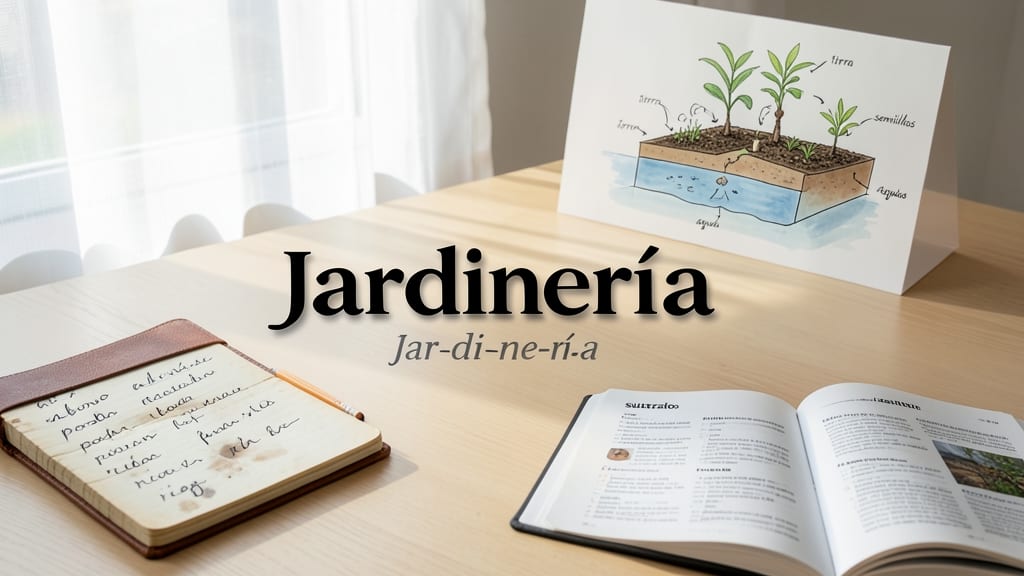
To say "gardening" in Spanish, use jardineria (pronounced hahr-dee-nee-ah), the standard term for growing plants and maintaining outdoor spaces. Specialized variations like huerticultura (vegetable gardening) or floricultura (flower gardening) cater to specific needs.
Spanish speakers use jardineria as their go-to term for all things related to plant cultivation, from tending flowers to growing vegetables. 🌱 The pronunciation is key—hahr sounds like "har" in "harbor," while -dee-nee-ah rolls off the tongue smoothly.
For those focusing on edible plants, huerticultura becomes essential, especially in Latin American regions where home gardens often double as food sources.
What’s fascinating is how regional dialects influence terminology. In Spain, you might hear jardinería more often, while Mexican gardeners commonly use huerta for vegetable patches. These variations reflect local gardening traditions and climate adaptations, making the language as diverse as the landscapes themselves.
💡 In This Article
- Spanish Gardening Vocabulary: Key Terms for Plant Care
- Regional Spanish Gardening Slang and Specialized Terms
Spanish gardening vocabulary: key terms for plant care
The foundation of Spanish gardening language starts with soil, called suelo (pronounced soo-eh-loh). This term encompasses everything from garden beds to potting mixes, and understanding it helps you communicate about soil quality, texture, or amendments.
For example, suelo arcilloso means "clay soil," while suelo arenoso refers to sandy soil—both critical for plant health and water retention.
Pruning, or poda (pronounced poh-dah), is another essential term that gardeners use daily. The technique involves cutting back plants to encourage growth, and the word comes from the Latin podare, meaning "to cut."
In Spanish-speaking regions, you'll hear variations like poda de formación (formative pruning) or poda de mantenimiento (maintenance pruning), each with specific timing and tools. 🌿 For instance, fruit trees often require poda de invierno (winter pruning) to prevent disease spread during rainy seasons.
Fertilizing, known as abonado (ah-boh-nah-doh), refers to enriching soil with nutrients. The term derives from abonar, meaning "to fertilize," and it’s used for both organic (like compost) and synthetic fertilizers. In Spanish, you might say abono orgánico for compost or abono químico for synthetic options.
The key difference lies in how nutrients are delivered—organic fertilizers release nutrients slowly, while chemical fertilizers provide an immediate boost.
Seasonal tasks, or labores estacionales (lah-boh-res es-tah-see-oh-nah-les), are vital for maintaining a thriving garden. These include planting (siembra), weeding (deshierbe), and harvesting (cosecha). For example, in Mediterranean climates, siembra de otoño (autumn planting) is crucial for winter crops like lettuce or carrots.
Meanwhile, tropical regions might focus on riego por goteo (drip irrigation) year-round due to consistent heat.
Here’s a quick reference for common tools and their Spanish names:
- Shovel: Pala (pah-lah)
- Pruners: Tijeras de podar (tee-heh-rahs de poh-dahr)
- Watering can: Regadera (reh-gah-deh-rah)
- Gloves: Guantes (gwahn-tehs)
Mastering these terms unlocks deeper conversations about plant care, from diagnosing pests (plagas) to troubleshooting soil pH (pH del suelo). 🌱 Whether you're discussing abono casero (homemade fertilizer) or rotación de cultivos (crop rotation), the language bridges cultural gardening practices with practical knowledge.